Rodent infestations in Cincinnati compromise residential structural integrity and create biological contamination hazards. Mice can squeeze through an opening measuring 0.25 inches, while mature Norway rats force entry…
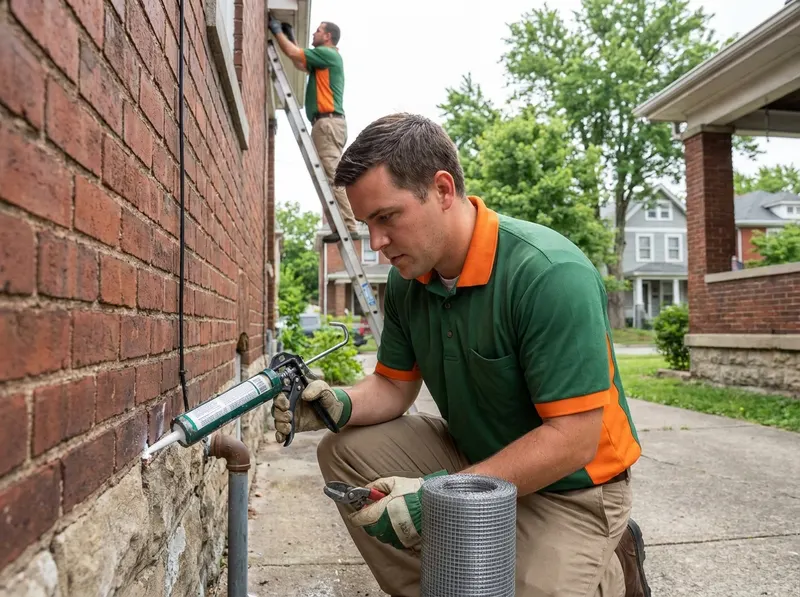
Rodent infestations in Cincinnati compromise residential structural integrity and create biological contamination hazards. Mice can squeeze through an opening measuring 0.25 inches, while mature Norway rats force entry through holes measuring 0.5 inches along foundation sills, fascia boards, and crawlspace vents. When unaddressed, rodents chew through electrical wiring, increasing fire risks documented by the U.S. Fire Administration, while simultaneously destroying blown-in fiberglass insulation. In historic multi-unit brick buildings across Over-the-Rhine and Clifton, century-old mortar deterioration creates sub-grade entry pathways. River-adjacent hillsides in Mount Adams, Mount Lookout, and Hyde Park frequently push brown Norway rats uphill from drainage basins toward heated basements as temperatures drop below 40 degrees Fahrenheit.
Effective defense requires permanent mechanical exclusion rather than repetitive chemical applications. Standard pest agreements often rely on recurring toxic bait replenishment that leaves poisoned rodents to expire within hidden wall voids. DesertCrown Pest Services implements Integrated Pest Management principles, utilizing 16-gauge galvanized steel hardware cloth, elastomeric caulking, and heavy brass wire mesh to physically close structural apertures. Properties bordering wooded tracts near Ault Park, Eden Park, or the urban canopy in Northside, Oakley, College Hill, and Pleasant Ridge encounter roof rats that scale downspouts and oak limbs to breach roofline soffits. Sealing these transitions halts the scent trails rodents use for directional navigation.
Eliminating structural contamination requires methodical staging to prevent disease transmission outlined by the Centers for Disease Control and Prevention. Rodent feces carry lymphocytic choriomeningitis and salmonella bacteria, which become airborne if sweepings occur without proper dampening. The field procedure follows a clear five-step structural defense sequence:
Choosing between basic interior trapping and comprehensive structural exclusion depends on property construction age and infestation severity. Single-room snap-trapping provides a temporary reduction for a solitary field mouse trapped inside a dry pantry, but it fails to resolve continuous colonization through foundation gaps. Comprehensive exterior exclusion requires an upfront mechanical labor investment, but it eliminates the need for endless monthly service retainers. Properties with shared party walls or attached garages demand broader perimeter barrier management governed under standards from the National Pest Management Association to ensure pests do not redirect into adjacent living quarters. For localized soil conditions in Hamilton County, review guidance through the OSU Extension Hamilton County, and cross-reference registered control materials with the Ohio Department of Agriculture, the ASTM International construction standards, the American National Standards Institute, and wildlife guidelines from the Ohio Department of Natural Resources.
Every job gets a firm, written price after an on-site visit.
Tell us about your rodent control and exclusion job in Cincinnati and we'll send a clear, written quote, usually the same day.
 DesertCrown Pest Services